

Epstein-Barr virus (EBV) is often described as a common, harmless infection. Most people remember it as “the kissing disease”—something you catch once, recover from, and leave behind.
But for some of us, the story doesn’t end there.
This piece exists because, while Epstein-Barr might be common, its long-term effects can be anything but. I am living proof of what happens when the virus doesn’t fully switch off.
Since 2009, I’ve been navigating the Epstein-Barr virus symptoms not because it was left untreated, but because it was never recognized. What followed was a fifteen-year journey of recurring illness, nervous system dysregulation, immune overload, and, eventually, a complete physical crash. My vagus nerve—the body’s built-in regulator—could no longer maintain internal balance.
This isn’t the story of being “just a bit tired.”
It’s the story of a post-viral condition that reshaped my body, my nervous system, and my life.
Epstein-Barr virus symptoms long term: Beyond Simple Fatigue
What is often labeled post-viral fatigue is not simply being tired after an infection. In my case, Epstein-Barr long-term effects disrupted energy production at a cellular level—a process still poorly understood in mainstream care.
A central piece of what was happening in my body was mitochondrial depletion. Mitochondria are the tiny power plants inside our cells; they convert oxygen and nutrients into usable energy. When a virus like Epstein-Barr remains active over a long period, these systems can become chronically impaired.
Instead of producing energy efficiently, the body begins to operate in a permanently depleted state. This is why rest no longer restores energy, why even minimal exertion feels disproportionately exhausting, and why symptoms like muscle weakness, cognitive fog, and delayed recovery become the norm. In my case, years of low-grade viral activity, layered on top of ongoing stress, meant my cells were running on empty long before the eventual crash became visible.
Mitochondrial depletion does not feel like ordinary tiredness. It feels as if the body’s basic energy supply has been interrupted—as if the internal battery no longer holds a charge.
Epstein-Barr may not be classified as a deadly virus, but its long-term effects can be profoundly life-altering. For me, it felt like my nervous system had become the threat — an internal alarm with no exit, and no way to explain it to anyone standing outside it.
When Epstein-Barr doesn’t go quiet
Epstein-Barr virus (EBV) lives in the body for life. In most people, the immune system keeps it dormant. But in some bodies—especially those with heightened neurological sensitivity—that regulation falters.
In my case, EBV became low-grade active after physical trauma in 2009 and never fully switched off. Each immune challenge flared it further: prolonged stress, emotional trauma, infections, antibiotics, vaccinations, shingles, COVID, chronic overstimulation. My immune system stayed in constant defense, never truly at rest.
This didn’t just tax immunity—it rewired my autonomic nervous system, governing energy, digestion, sleep, sensory processing, and stress. The result: chronic fatigue, brain fog, overstimulation, sleep disruption, hormonal chaos—culminating in full autonomic collapse in 2024.
At its worst, my brain fired relentless alarm signals: sparks behind my eyes, head heavy like a welded helmet, my body entered a state of internal emergency it couldn’t exit. To this day, that experience has not fully left my body. When the date comes around, I still feel it echoing—a quiet fear of waking in that state again. It remains my most mortifying experience.
Four months later came escalation: breathing de-automated, chest and arms gripped tight, burning meridians igniting from chest through armpits down my arms. Heart attack terror drove me to call an ambulance.
The paramedic ruled out cardiac issues: “You have a beautiful heart. Nothing’s wrong with the organ. Regular medicine and alternative approaches are converging—try breath work.” That was my nervous system in full emergency — not organ failure. A distinction that mattered, even if the experience felt identical.
Days after the ambulance, soft ringing began in my left ear—a persistent background hum. Tinnitus like this signals heavy stress on nervous system and hearing pathways, fitting EBV’s reach into nerves beyond blood or throat.
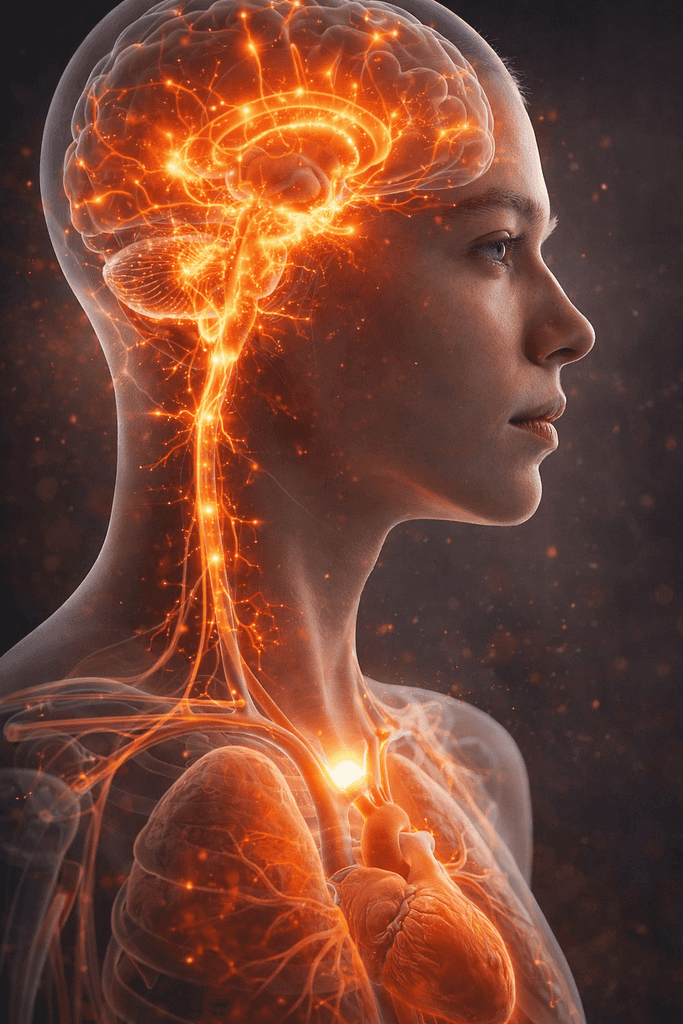
Finding Regulation After Epstein-Barr
Within conventional medicine, there is currently no clear pathway for actively guiding Epstein-Barr back into dormancy in chronic cases. My recovery therefore required approaches outside that framework—centered on immune regulation, nervous system stabilization, and reducing ongoing physiological stressors.
One of the first moments of real relief did not come from a diagnosis or protocol, but from touch.
During the initial emergency phase, my best friend—who is also my shiatsu therapist—came over unscheduled. She sensed, somehow, that I needed support. When she placed her hands on my head, she immediately felt the heat and activity concentrated there. Everything felt stuck at the top of my system—as if my body was running a full-scale internal alarm without an exit.
Through shiatsu, she didn’t “fix” anything. She helped redistribute the load. I could feel the intensity slowly moving downward—away from my head, through my throat, and into my body. That shift mattered. It didn’t end the crisis, but it moved me out of pure neurological overload and back into something survivable.
It was the first moment my system remembered that regulation was still possible.
Long COVID Diagnosis, EBV Reality
Diagnosed with Long COVID, I found the label captured surface symptoms but missed my underlying nervous system crisis entirely. It offered no pathway for the acute alarm state consuming me.
The diagnosis offered no pathway for my acute alarm state—no interventions targeting the hyper-activated wiring consuming me.
Long COVID hits even healthy bodies with lingering fatigue, breathlessness, brain fog, cardiovascular issues. EBV post-viral fatigue plays out differently in hypersensitive terrain like mine. The virus doesn’t act alone—it collides with pre-existing neurological vulnerability, mitochondrial fragility, immune dysregulation. What seems “common” becomes life-altering.
Long COVID often follows more linear paths. My EBV waves flare with my internal terrain—nervous system flares, not just viral persistence.
Without a conventional plan—and my crisis escalating—I turned beyond regular medicine. Not from rejection, but necessity. Therapies delivering regulation, stabilization, relief became survival while my body stayed in emergency.
Treating Epstein-Barr’s Root Cause
Within conventional care, the only concrete support that followed was occupational therapy. This proved valuable for pacing, energy management, and preventing further crashes. It helped me cope with the consequences. It was also one of the few places within the conventional system where my experience was taken seriously — where the focus wasn’t on questioning my symptoms, but on helping me navigate them. While it didn’t address the underlying viral activity, it offered containment and practical structure at a time when everything else felt medically undefined.
My symptoms were still being driven by the Epstein-Barr virus symptoms—viral activity and a nervous system locked in prolonged stress response. With no medical pathway offered to influence that process directly, I began searching for ways to support my body at the root level.
That search led me to bioresonance therapy—not as a rejection of regular medicine, but as a way to actively engage viral load, immune signaling, and nervous system stress when no other options were available. After six treatments, EBV shifted into remission—measurable proof the approach reached the viral root.
Quantum Sensitivity + EBV
One crucial layer in my story is that I have a quantum-sensitive body —a system that processes stimuli and environmental input more intensely than average.
This includes electromagnetic hypersensitivity (EHS), a sensitivity that amplifies internal stress signals rather than creating them from scratch. In a system already struggling with viral load and dysregulation, that amplification matters. Stichting EHS (the Dutch Foundation for Electromagnetic Sensitivity) recognizes this as a real, lived complaint pattern, even if mainstream medicine still struggles to classify it.
While public attention around electromagnetic environments and human performance is relatively recent, Aires has been examining this relationship for decades through research, patents, and real-world application. Their work centers on what they describe as environmental clarity — not blocking technology or escaping the modern world, but creating electromagnetic environments that are more supportive of the body’s ability to recover, regulate, and function coherently.
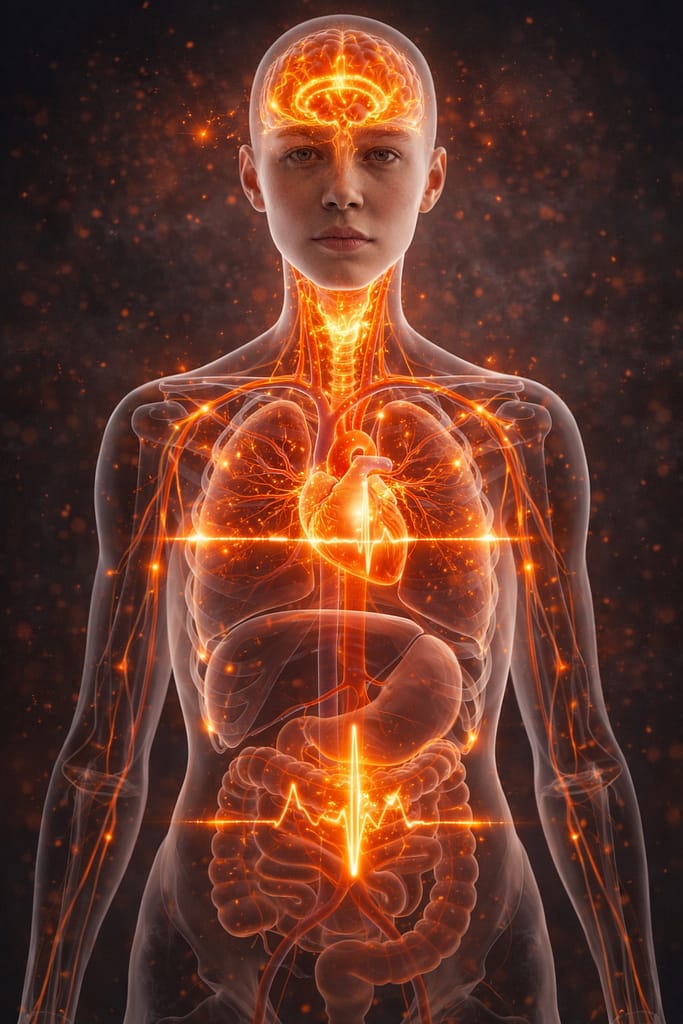
In a body like mine, Epstein-Barr did not act alone. Viral long-term effects, chronic overstimulation, and nervous system sensitivity created a feedback loop that locked my system in survival mode.
This is not psychological.
This is not “just stress.”
This is a biological system that never fully powered down.
Wrong Questions, EBV Crisis
One of the hardest realizations: Epstein-Barr’s long-term effects fit poorly into medical frameworks.
I keep getting the wrong questions:
“When did you get infected?”
“Have you seen a neurologist?”
“Isn’t EBV common?”
Those miss the core issue. Most carry EBV. My problem: immune system that couldn’t fight or stand down. The alarm stayed on.
EBV spans immunity, neurology, endocrinology, autonomic regulation—falling between specialties. Checkboxes don’t match reality.
Last year, vision worsened—a crushing blow when energy is rationed. Eye doctor on post-viral fatigue: “What’s that? Neurologist?”
Dominant left eye failed first (right eye normal), straining compensation. Months earlier: left ear tinnitus. Same-side cranial hits across time follow EBV’s neurological pattern, not aging’s symmetry.
Second optician connected visual chaos to energy depletion. New glasses helped. Irony: eye doctor’s failed Rx now tested as screen glasses.
Deadly viruses get protocols fast. Life-altering ones erode silently—no biomarkers, no emergency triggers. Post-viral patients become case managers by necessity.
What Actually Changed
Nothing “clicked” inside the regular medical system. What changed is that I did.
There was no protocol waiting for me. No roadmap. No specialist who connected the dots. Over time, it became clear there is simply no structured route for Epstein-Barr long-term effects within conventional medicine.
So I gathered information. I listened to my body. I tracked patterns no one else was asking about. I noticed what worsened my symptoms and what supported them.
Most of what helped came from outside the conventional framework—through nervous system regulation, trauma-informed therapy, pacing, complementary treatments, and bioresonance. Not because I rejected medicine, but because there was no place for my condition inside it.
In the past two years, I’ve come a long way. Not by being “fixed,” but by learning to work with my body instead of against it.
The Quiet Grief
Yet the reality remains complex. I’m still dependent on systems that don’t fully know how to hold someone like me—systems built around timelines and diagnoses that don’t reflect lived complexity. That mismatch brings uncertainty: medically, practically, emotionally.
And then there is the quiet grief — not a phase I passed through, but a layer I learned to carry. Grief for years spent misunderstood. For the isolation when others cannot grasp your reality. For the loss of safety chronic illness brings — not just in the body, but in relationships. For not fitting into structures meant to hold you.
Naming it didn’t dissolve it. But it made it load I could work with — not weight that worked against me.“
The invisibility of this struggle compounds the hardship. No outward marker reveals the monumental effort required for basic functioning. I don’t “look sick,” even as my body remains locked in internal emergency.
That invisibility adds a second layer of strain: the constant need to explain, justify, and translate an unseen reality—not just to medical systems, but often to those closest to me. The gap between my outward appearance and the internal load I carry is painful, isolating, and profoundly exhausting.
Healing requires safety. And safety becomes harder to access when your reality is invisible or difficult to translate.
And beneath it all runs loneliness—not just from medical gaps, but from my inner circle who don’t see my reality or accept my methods. No safety net. No shared understanding. When systems ask the wrong questions, even those closest reveal their own blind spots. Invisible illness doesn’t just steal energy; it steals belonging. Rebuilding that — on your own terms, with the people who can hold it — becomes part of the structural work.
This journey with Epstein-Barr long-term effects didn’t just change my body—it became the foundation of my work: guiding others through the invisible gaps where medicine ends and embodied wisdom begins.
Where I am now
I don’t yet know what the next phase of healing will look like.
I know what has helped.
I know what harms me.
I know my body far better than I ever did before.
I am still navigating a world that has not yet caught up with Epstein-Barr long-term effects and conditions like mine. That uncertainty is real.
And so is the progress.
Both can exist at the same time.
Want to go deeper? Aires’ own researchers wrote an in-depth article on the link between electromagnetic environments and chronic illness — published right here on this blog. Read it here →

About the author
I’m Tani — writer, educator, and someone who has spent fifteen years learning to read her own body like a map. Based in Amsterdam, I navigate the crossroads of EMF awareness, post-viral healing, and nervous system regulation. Not from theory — from lived experience. This space exists for the ones who feel things deeply, who sense what others miss, and who are done being told it’s all in their head. Subscribe to Whispers from the Field — a quarterly newsletter for the quantum sensitive. No noise. Just signal.
The Indigo Healing Guide
Fifteen years of living with Epstein-Barr, post-viral fatigue, and quantum sensitivity — distilled into the guide I desperately needed and couldn’t find anywhere. Part memoir, part manual. Written for anyone navigating the invisible gaps where medicine ends and embodied wisdom begins. I made it because I needed it. And because you might too.